

A post-money valuation does not automatically equal fair value under IFRS 13. While a recent financing round may provide strong evidence of value, valuation professionals must assess whether the transaction remains representative of market participant assumptions at the reporting date and whether share-class rights, company performance, market conditions or financing terms require adjustments.
IFRS 13 requires fair value to reflect the price that would be received to sell an asset in an orderly transaction between market participants at the measurement date. As a result, a recent transaction price is an important valuation input, but it is not automatically the fair value conclusion.
| Fair value | “The price that would be received to sell an asset or paid to transfer a liability in an orderly transaction between market participants at the measurement date.” – FRS 113.9, the equivalent of IFRS13 |
| Entry vs exit | The transaction price is an entry price; fair value is an exit price. Entities do not necessarily sell assets at the prices paid to acquire them – FRS113.57 |
| Post-money valuation | Not a defined term under the accounting standards, the IPEV guidelines or the IVS. Market shorthand for the value implied by the latest round |
Why This Matters for Fund NAV
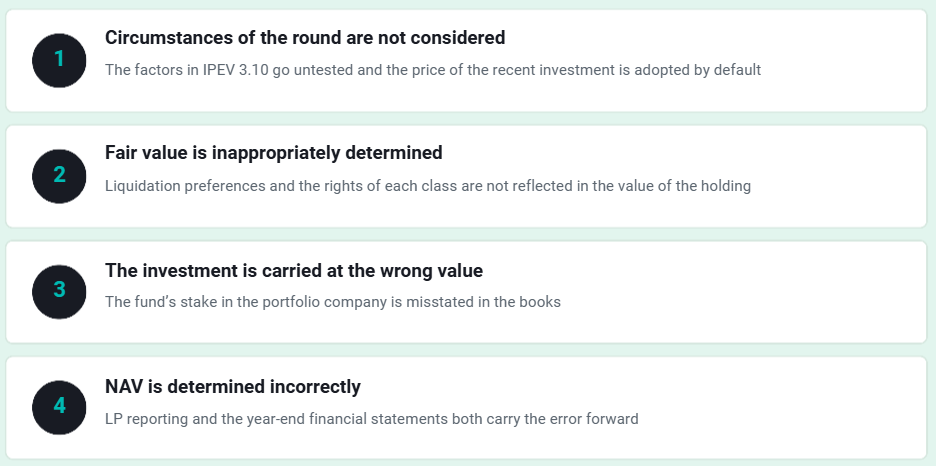
For PE and VC funds, using post-money valuation without assessing share-class rights, market conditions, and transaction relevance can lead to NAV misstatements, audit challenges and inconsistent investor reporting.
Why Post-Money Valuation Is Not Automatically Fair Value Under IFRS 13?
A recent funding round can provide important evidence of value and, in some circumstances, may support a fair value conclusion. However, valuation professionals must assess whether the transaction remains relevant at the reporting date and whether different share classes have materially different economic rights.
Under IFRS 13, fair value must reflect:
Share-class rights and preferences
Market participant assumptions
Facts and circumstances at the reporting date
How IFRS 13 and IPEV Treat Recent Financing Rounds?
IFRS 13 and the IPEV Valuation Guidelines recognise recent transaction prices as important valuation inputs. However, valuation professionals must assess whether market conditions, company performance, financing terms or share-class rights have changed since the transaction date before concluding that the transaction price remains representative of fair value.
In practice, recent financing rounds are often used as a calibration point. Valuation professionals assess whether changes in company performance, market conditions, capital structure or investor assumptions since the transaction date indicate that adjustments are required at the reporting date.
Transaction price can equal fair value – but that is a conclusion to be tested at each measurement date, not an assumption.
How Share-Class Rights Affect Fair Value
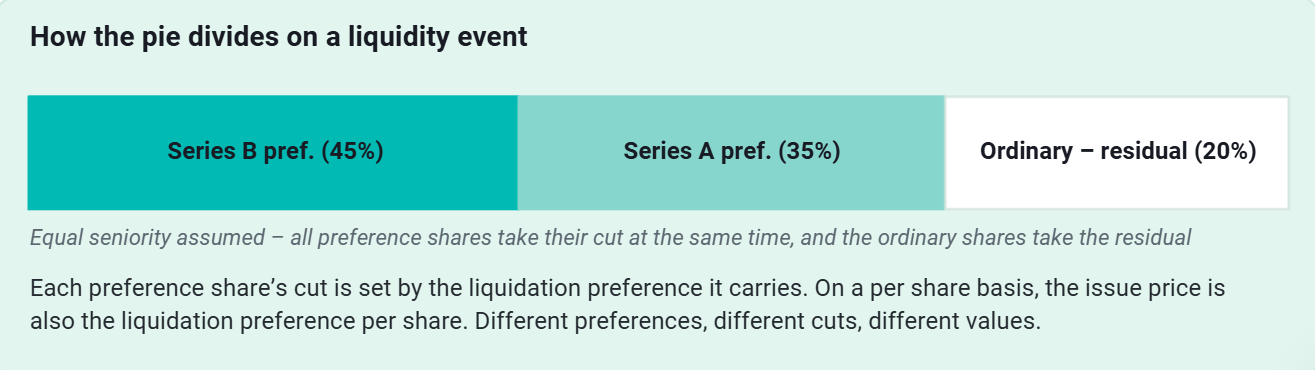
Economic rights such as liquidation preferences, participation features and conversion terms influence how value is allocated across share classes. Therefore, the price of one preference share class may not represent the fair value of another.
Choosing the Right Valuation Method
Early-stage investments: Hybrid Method and OPM are commonly used where share-class rights significantly affect outcomes.
IPO-ready or exit-stage companies: Common-equivalent or fully diluted approaches may become more appropriate.
The further an investment sits from an exit, the more the differences between share classes must be modelled rather than assumed away.
Common Valuation Watch-Outs
Applying one financing round price across different share classes
Ignoring liquidation preference seniority
Valuing all preference shares identically
Combining share classes that have materially different economics
How Valuation Flows Through to NAV
Fair value assumptions flow directly into:
Fund NAV calculations
LP reporting
Financial statements
Audit reviews
Governance and regulatory oversight
NAV Reporting Impact: Robust fair value measurement is essential for reliable NAV reporting under IFRS and IPEV expectations.
Navigating Complex Fund Valuations and NAV Reporting
For PE and VC funds, valuation decisions directly affect NAV reporting, investor reporting, audit reviews and governance outcomes. Baker Tilly's valuation specialists support fund managers, fund administrators, CFOs and finance teams with IFRS 13-compliant fund valuations, complex capital structure analyses, NAV reporting support and independent fair value assessments for audit and investor reporting purposes.


Related content


