

Why Section 19B Valuations Matter
Writing-down allowances (WDA) under Section 19B of the Singapore Income Tax Act 1947 (SITA) are granted on capital expenditure incurred in acquiring qualifying intellectual property rights (IPRs). Where prescribed thresholds are exceeded, the claimant must submit a third-party independent valuation report supporting the Open Market Price (OMP) of the acquired IPRs as at the acquisition date.
| Report rejected by IRAS | Insufficient information on the valuer’s analysis, reasoning and support could result in rejection of the valuation report. |
| WDA disallowed | Where the value of qualifying IPRs cannot be reliably determined from the report, the Section 19B WDA may be disallowed. |
| Allowance capped at the lower value | Where the OMP falls below the capital expenditure incurred, IRAS may grant WDA on the lower amount. |
| Later compliance challenge | A report may be subject to routine tax compliance review, and IRAS may request additional information to address gaps in the quantitative inputs or qualitative assumptions. |
Understanding the Section 19B Reporting Framework
IRAS' requirements for a Section 19B valuation report are established through legislation and supporting documentation. These include Section 19B of the SITA, the Declaration Form, and the IRAS Section 19B Guide. Together, these set out both the legal requirements and the minimum content expected in a valuation report. The IVAS Guidance Note does not constitute official IRAS guidance or represent IRAS’ position.
The 13 information requirements outlined in the Section 19B Guide can be grouped into six key areas:
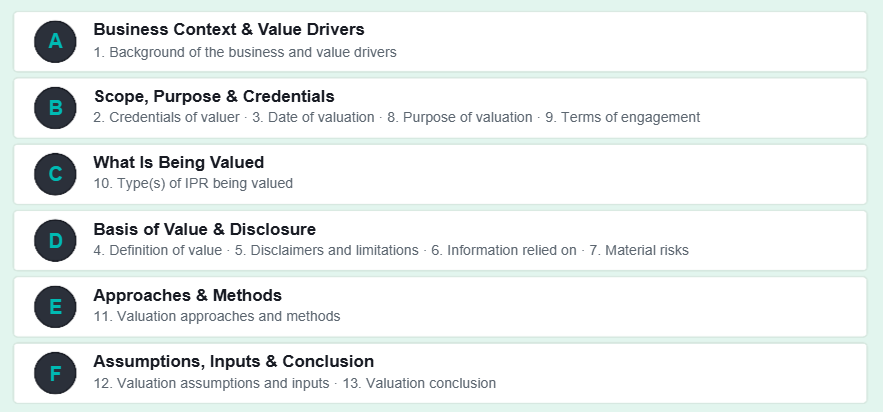
Subject to the relevant value thresholds, a claimant must comply with the prescribed Declaration Form and independent valuation report requirements when making a Section 19B claim.
A. Business Context and Value Drivers
The valuation report should explain how the economic benefits attributed to the IPRs are supported by business and market fundamentals. Significant assumptions should be reasonable, supported by available evidence, and relevant to the intended use of the valuation.
What the report should analyse, where applicable:
| Industry | Key drivers, outlook and future growth prospects of the industry the company operates in |
| The company | Business segments, geographical markets and the revenue of each segment |
| Products & market | Product life cycle, competitor offerings, customer and competitor profiles, market share |
| The IPRs | Historical performance, economic outlook, and how the IPRs support strategy and competitive advantage |
Depending on the nature of the IPRs, relevant value drivers may include
- Competitive advantage from exclusive rights
- Barriers to entry against replication
- Premium pricing from perceived exclusivity
- New revenue streams through licensing or franchising
Common shortcomings include failing to link identified value drivers to projected economic benefits, overlooking industry obsolescence risks, and ignoring competing or substitute technologies that may affect the value of the IPRs.
The analysis should explain how the identified value drivers support the projected economic benefits attributed to the IPRs.
B. Scope, Purpose and Valuer Credentials
A Section 19B valuation report provides an independent opinion of the OMP of the acquired IPRs as at the acquisition date, for the purpose of supporting the claimant’s Section 19B submission to IRAS. Accordingly, the scope of work must be agreed at the outset and be appropriate for this purpose.
The report should demonstrate:
- Name, qualifications, licences and professional memberships
- Experience valuing similar IPRs, or IPRs in similar industries
- Terms of engagement, included in the valuation report
- The appropriate valuation date
- The purpose for which the valuation is carried out
Reports should also avoid relying on hindsight. The valuation must be based on information known or knowable at the acquisition date rather than subsequent developments.
The report should state its purpose, demonstrate the valuer’s relevant competence, address potential conflicts of interest, and be anchored to information known or knowable as at the acquisition date.
C. What is Being Valued
For Section 19B purposes, qualifying IPRs are statutorily defined and are narrower than “intangible assets”. The OMP reflects the price at which the asset would change hands between a willing buyer and willing seller under arm’s-length conditions as at the relevant date.
Qualifying IPRs may include:
- Patents, copyright, trademarks and registered designs
- Geographical indications and plant variety protection
- Layout-designs of integrated circuits
- Trade secrets or information having commercial value
Claim condition:
- The claimant must be the legal and economic owner of the acquired IPRs, subject to the conditions stated in the Declaration Form.
Valuers should carefully distinguish qualifying IPRs from non-qualifying components. Customer-related intangibles, customer information, and certain process-related knowledge may not qualify under Section 19B. Similarly, brand value should not automatically be equated with trademark value, and future IPRs expected to arise from post-acquisition R&D should not be included.
Clearly distinguish qualifying IPRs from non-qualifying components and support the claimant’s legal and economic ownership of the acquired IPRs.
D. Basis of Value and Disclosure
The basis of value must be appropriate for the intended use, and the source of its definition must be cited. The report must also be transparent about what the valuer relied on and the risks identified.
The valuation report must set out:
| Basis of value | OMP as defined in Section 19B(10F) of the SITA, with the source of the definition cited – IRAS accepts bases with the same meaning, including market value |
| Information relied on | The information used and its source, especially where the information comes from the company commissioning the report, with the supporting evidence made available |
| Material risks | Risks underpinning the valuation, described in enough detail to show the valuer gave them due consideration |
| Disclaimers | Any disclaimers or limitations affecting the valuation process or the value, with their effect explained |
Importantly, valuations should distinguish between price and value. Price reflects what is paid or offered, while value reflects the valuer's conclusion as at the valuation date.
State the basis of value, cite its source, and document the analysis, as IRAS may request additional information during a subsequent compliance review.
E. Approaches & Methods
Under IVS 103, valuers should select the valuation approach most appropriate for the intended use, considering how independent market participants would price the IPRs
The three valuation approaches are:
| Market Approach | Prices of identical or comparable assets – rarely available for IPRs |
| Cost Approach | Replacement cost of a similar asset or an asset providing similar utility, generally considered where other approaches cannot be applied satisfactorily. |
| Income Approach | Future income or cost savings discounted to present value – most common |
For Section 19B valuations, commonly applied income methods include:
| Relief-from-Royalty Method (RFRM) | Royalty savings from ownership – may be more appropriate where the economic benefits arise from licensing the IPRs for commercialisation by another party. |
| Multi-Period Excess Earnings Method (MPEEM) | Excess earnings after deducting contributory asset charges – may be more appropriate where the IPRs are used by the business to generate revenue and profits. |
When applying the RFRM, valuers should exercise caution where comparable licence agreements differ materially from the subject IPRs in terms of rights granted, industry, geography, technology lifecycle, revenue potential, customer base, or competitive environment.
A comparability analysis undertaken for another purpose, including a purchase price allocation, should not be adopted without assessing whether it is sufficiently relevant to the particular qualifying IPRs, valuation date, basis of value and Section 19B reporting purpose. Limited market evidence and changes in market conditions since comparable licences were executed may further affect reliability. Under the MPEEM, care should be taken to exclude non-qualifying components from excess earnings and ensure that only benefits accruing to the claimant are included.
Valuers should also avoid excessive reliance on management projections without independently assessing their reasonableness against available market evidence.
Consider the appropriateness of the principal approaches, justify the method selected and, where useful, corroborate the conclusion using another method. Material differences between methods should be investigated and explained.
F. Assumptions, Inputs and Valuation Conclusion
The credibility of a valuation depends heavily on the assumptions and inputs employed. Key areas that should be clearly supported in the report include:
| Economic life | Legal life, protection, usage and obsolescence Excludes any extension from post-acquisition R&D |
| Projections | Benefits attributable to the qualifying IPRs Group revenue excluded unless licensing supports it |
| Royalty rate | Benchmarked from comparable licences Industry, relationship, scope of rights, payment terms |
| Discount rate | Reflecting risks specific to the IPRs A company WACC, which reflects the broader business, may require adjustment or further analysis before it is applied to IPR cash flows. |
| Conclusion | A single point value for the Section 19B claim With the basis for arriving at that point value stated |
The IVS framework emphasises maximum use of relevant observable data, application of professional judgement and scepticism, explanation of adjustments, and maintenance of supporting documentation throughout the engagement.
A common challenge arises where valuation inputs are selected without sufficient support. Economic life assumptions, revenue forecasts, royalty benchmarks, and discount rates should all be grounded in documented analysis rather than judgement alone. Section 19B also requires a single point value conclusion, with the basis for arriving at that conclusion clearly explained.
Material assumptions and inputs should have a clear, documented basis, with the valuer’s professional judgement and any limitations transparently explained.
What a Strong Report Does
- States its purpose and basis of value, and evidences the valuer's competence
- Isolates qualifying IPRs from non-qualifying components and addresses legal and economic ownership.
- Evaluates all three valuation approaches and justifies the method selected
- Supports economic life, projections and both royalty and discount rates with evidence, and discloses material risks.
- Concludes on a single point value, with the basis clearly explained
How Baker Tilly can help:
An independent IPR valuation prepared specifically for Section 19B purposes, applying IVS and the IVAS Guidance Note, with clear analysis of qualifying and non-qualifying components and documentation to support subsequent IRAS review.


Related content


